Best AI Laptops 2026: Top NPU-Powered Picks for Performance, Portability & Real AI Work

The AI Laptop Scene in 2026: What's Actually Changed
Look, the AI revolution has changed what we expect from laptops, but not every machine with "AI" slapped on the box deserves your money. Finding the best AI laptops 2026 matters if you're serious about using these features—not just having them sit idle while you browse Reddit.
Modern AI-enabled machines aren't just faster. They're genuinely smarter, packing dedicated Neural Processing Units (NPUs) that crunch through machine learning tasks without draining your battery in 90 minutes. At CES 2026, manufacturers unveiled 15 groundbreaking laptops with real AI capabilities—from on-device language translation that actually works to battery optimization that extends life by 30-40%.
These aren't your standard ultrabooks with a marketing sticker. They're purpose-built machines designed to accelerate workflows for AI engineers developing the next algorithm, content creators using Stable Diffusion locally, or professionals running LLMs without constant cloud dependency.
So which AI laptop actually deserves your cash? Let me break it down.
1. ASUS ROG Flow Z13 – The Sweet Spot for Most People
Why I'm Recommending This First
The Asus ROG Flow Z13 hits the goldilocks zone that most AI laptops miss. It's the top AI laptop 2026 if you want actual portability with genuine AI horsepower. Most "AI laptops" are either powerful bricks or lightweight toys—this one actually balances both.
What makes it special? The 2-in-1 convertible design isn't just a gimmick. The detachable keyboard and 360-degree hinge mean you can use it as a tablet when you're reviewing AI-generated content, then flip it back to laptop mode for serious work. According to TechRadar's exhaustive laptop testing, the Z13 crushes performance benchmarks despite being genuinely portable.
The device handles both casual AI apps (like running ChatGPT alternatives locally) and serious professional work (training custom models, running Stable Diffusion). And unlike most gaming laptops marketed as "AI machines," this one won't destroy your shoulder carrying it around.

Asus ROG Flow Z13 - The best
🔥 Best Overall Pick
Check Current Amazon Price →Technical Features That Actually Matter
The Asus ROG Flow Z13 packs specs that justify its price tag. Intel's latest 13th-gen processors come with dedicated NPU capabilities hitting 45 TOPS of AI performance—that's not marketing fluff, it's what lets you run language models locally without your laptop turning into a space heater.
Here's what you get: up to 32GB of LPDDR5 RAM (soldered, so buy the config you need upfront), PCIe 4.0 SSD up to 2TB, and a 13-inch 4K display with 100% DCI-P3 color accuracy. That color accuracy matters if you're working with AI image generation—you want to see what your Stable Diffusion outputs actually look like.
The cooling system is surprisingly effective. Most laptops this thin thermal throttle after 10 minutes of serious AI work. The Z13 actually maintains performance, which The best laptops 2026 tested, reviewed and rated confirmed in sustained benchmark tests.
The Downsides (Because Nothing's Perfect)
The convertible design is versatile, but if you're typing long documents for hours, the keyboard-as-cover design gets annoying. It doesn't have the stability of a traditional laptop hinge. Some people hate it. I find it fine, but test it first if you can.
Battery life is the other compromise. Like most NPU laptops prioritizing performance, you're looking at 5-6 hours under actual AI workloads—not the 12+ hours manufacturers claim testing with the screen at 25% brightness doing absolutely nothing. The best laptops you can buy in 2026, tested and reviewed confirms this reality—AI-focused devices trade battery for computational muscle.
And yeah, it's expensive. But it's cheaper than most gaming laptops with similar specs, and way cheaper than going full workstation.
Oh, and the detachable keyboard means you've got one more thing to keep track of when traveling. Lose it and you're out $150+ for a replacement.
✅ Pros:
- Actually portable at 2.6 lbs
- 45 TOPS NPU for real AI work
- Excellent 4K display with accurate colors
- 2-in-1 design that's useful, not gimmicky
- Effective cooling for sustained performance
- Lower price than comparable gaming laptops
❌ Cons:
- Keyboard design not ideal for long typing
- Battery life suffers under AI loads (5-6 hrs)
- RAM soldered—buy the right config upfront
- Detachable keyboard is another thing to lose
- Premium pricing (though justified)
2. MSI Titan 18HX – The Nuclear Option
When You Absolutely Need Maximum Power
The MSI Titan 18HX is what happens when you ask "how much performance can we cram into something technically portable?" It's a desktop replacement disguised as a laptop. If you need uncompromising performance in AI powered laptops, this is your machine.
This thing doesn't mess around—18-inch display, latest Intel Core i9 processors, NVIDIA's flagship RTX 5090 graphics, and a cooling system that could probably chill beer. It's designed for people training serious AI models, running multiple LLMs simultaneously, or doing heavy 3D rendering alongside AI work.
Best Laptops for AI Engineer (2026) - Budget to High End! highlights the Titan 18HX as the go-to for professionals who need workstation power but can't be chained to a desk. Just know what you're getting into—this is "portable" in the technical sense only.

MSI Titan 18HX - Maximum Power
🚀 Maximum power: For serious AI professionals → See latest pricing on Amazon
Performance That Embarrasses Desktops
The specs are absurd in the best way. Intel Core i9-14900HX processor, NVIDIA RTX 5090 with 24GB VRAM, up to 48GB DDR5 RAM (upgradeable!), and dual NVMe SSDs in RAID for insane transfer speeds. This configuration handles AI model training that would choke most desktops.
During actual AI workloads—training custom models, running Stable Diffusion XL, processing massive datasets—the Titan 18HX maintains performance without thermal throttling. That's remarkable for a laptop. The RTX 5090's 16,384 CUDA cores accelerate machine learning tasks so effectively that cloud compute starts looking expensive by comparison.
And it's genuinely versatile. Want to game at max settings? Go for it. Need to run AAA games while an AI model trains in the background? Somehow, it handles that too. Most laptops would catch fire attempting this.
The Reality Check
This laptop weighs over 7 pounds. Add the power brick (which is basically a brick), and you're carrying 10+ pounds. Your back will hate you. It's "portable" like a 27-inch iMac is portable—technically yes, practically no.
Battery life is a joke for anything serious. Under AI workloads, you get 2-3 hours max. Gaming? Maybe 90 minutes. It's a desktop replacement that needs to stay plugged in. The cooling fans sound like a jet engine under load—forget using this in quiet environments.
And the price. At $5,000-6,000, you could build a genuinely powerful desktop rig. Or you could get this if mobility matters enough to pay the premium. For what it's worth, budget-conscious folks looking at emerging alternatives like the Snapdragon X2 Elite can get impressive AI capabilities at way more accessible prices.
✅ Pros:
- Desktop-level performance in laptop form
- RTX 5090 with 24GB VRAM crushes AI tasks
- 48GB RAM, upgradeable
- Effective cooling prevents throttling
- Gorgeous 18" mini-LED display
- Handles gaming + AI simultaneously
❌ Cons:
- Weighs 7+ lbs (10+ with power brick)
- Battery dies in 2-3 hours under load
- Fans are LOUD during intensive work
- $5,000-6,000 price tag
- Not actually portable for travel
- Power brick is comically large
3. Copilot+ PC (HP OmniBook 7 AI) – The Sensible Choice
Microsoft's AI Vision Done Right
Copilot+ PCs represent Microsoft's bet on AI-integrated computing, featuring dedicated NPUs delivering at least 40 TOPS. These machines blend traditional laptop functionality with AI capabilities that actually work—real-time translation, intelligent photo editing, productivity tools that don't feel like demos.
The HP OmniBook 7 AI is my pick for the best Copilot+ PC implementation. It's not flashy. It doesn't have ridiculous specs. It's just a solid, well-built laptop that does AI tasks efficiently without breaking the bank or your back.
What sets Copilot+ PCs apart? They run AI workloads locally without constant cloud connectivity. While competitors like the Apple M5 Pro/Max chips excel in creative workflows, Copilot+ PCs focus on workplace productivity and Microsoft ecosystem integration. Windows Studio Effects for video calls, AI-powered writing assistance, intelligent file organization—stuff that actually saves time daily.
Price ranges from $1,199 for entry configs to $1,499 for maxed specs. The HP OmniBook 7 AI hits the sweet spot at $1,299. Battery life is legitimately good—12+ hours of normal use, 8-9 hours with AI tasks running. The NPU helps by offloading tasks that would otherwise hammer the CPU.

HP OmniBook 7 AI - Copilot+ PC
💼 Best for Productivity
Check Amazon Deals →Copilot+ Features That Actually Matter
The Recall feature is genuinely useful if privacy concerns don't freak you out. It creates a searchable timeline of your computer activity—screenshots every few seconds. Lost that doc you were reading last week? Just search for it naturally. "Show me the spreadsheet about Q4 projections" and boom, there it is.
Live Captions with translation works shockingly well. Join a call with someone speaking Spanish? Live translation appears on screen. Not perfect, but good enough for meetings. And it's all happening locally on your NPU—no cloud dependency, no privacy concerns about your conversations being processed remotely.
Cocreator in Paint generates AI artwork from text prompts. It's not Midjourney quality, but it's faster and more private for quick mockups. And yeah, it works offline.
Even gaming laptops like the MSI Titan 18HX benefit from Copilot+ integration—you get productivity features alongside gaming muscle. The HP OmniBook isn't a gaming machine, but it handles professional AI tasks brilliantly.
The Limitations You Should Know
Early adoption always has challenges. Software compatibility isn't perfect—many AI apps haven't optimized for NPU acceleration yet. So your expensive NPU sometimes sits idle while your GPU does the work anyway.
Battery life claims are... optimistic. Microsoft says "all-day battery." Reality? 12 hours doing light work, 8-9 hours with AI features active. Still good, but not magic. Thermal management under sustained load isn't as good as dedicated gaming laptops like the Asus ROG Zephyrus 2026 with its advanced cooling.
The ecosystem is maturing but limited. Fewer third-party apps leverage the NPU compared to traditional GPU-accelerated solutions. You're betting on future software support more than current capabilities.
✅ Pros:
- Affordable ($1,200-1,500)
- Genuinely good battery life (12+ hrs light use)
- Local AI processing (privacy-friendly)
- Recall feature surprisingly useful
- Real-time translation works well
- Lightweight and portable
❌ Cons:
- Software ecosystem still maturing
- Not all apps optimize for NPU
- Battery life overstated by Microsoft
- Thermal management so-so under load
- Recall privacy concerns for some users
- Limited third-party NPU support
4. Apple M5 Pro MacBook Pro – The Mac Ecosystem King
If You're Already on Mac, This Is Your Answer
The Apple M5 Pro MacBook Pro is phenomenal if you're locked into Apple's ecosystem. The unified memory architecture and battery life are unmatched. Seriously—15+ hours doing actual work, not manufacturer testing BS.
The M5 Pro delivers around 38 TOPS of AI performance. That's slightly behind competitors on paper, but Apple's software optimization makes it feel faster. Final Cut, Logic Pro, Adobe apps—everything flies. The neural engine handles AI tasks so efficiently that battery impact is minimal.
Build quality is Apple-level perfect. The keyboard is excellent. The trackpad is the best in the business. The display is stunning—mini-LED with actual HDR that doesn't look washed out.
BUT—and this is important—you need to be in Apple's ecosystem for this to make sense. If you're running Windows apps, dual-booting, or using software that hasn't been optimized for Apple Silicon, this is the wrong choice.

Apple M5 Pro - The Mac Ecosystem King
🍎 Mac users only: Best if you're already in the ecosystem → Find deals on Amazon
What Makes the M5 Pro Special
The unified memory architecture is the secret sauce. Instead of separate pools for CPU, GPU, and Neural Engine, everything shares one fast memory pool. No data copying between components—just instant access. This is why a MacBook with 32GB RAM often outperforms Windows machines with 64GB.
AI tasks that crush other laptops? The M5 Pro handles them while barely warming up. Image processing in Photoshop, video editing with AI tools, running LLMs locally—it all just works smoothly.
Battery life is legitimately 15+ hours for normal use. Even with AI workloads active, you're getting 10-12 hours. That's double what most Windows AI laptops deliver.
The Deal-Breakers for Some People
You're paying Apple tax. A comparable Windows laptop costs $1,000 less. You're paying for the ecosystem integration, build quality, and that gorgeous display.
Gaming is limited. Sure, some games run, but the library is tiny. If you game seriously, this isn't it.
Upgradeability is zero. RAM is soldered. Storage is soldered. Buy the config you need upfront because there's no upgrading later. And Apple charges $400 to go from 32GB to 64GB RAM—that's highway robbery when RAM costs $150 retail.
Software compatibility remains an issue. Many AI tools still don't have proper Apple Silicon support. You'll find yourself running x86 versions through Rosetta, which defeats the performance benefits.
✅ Pros:
- Best-in-class battery life (15+ hrs)
- Unified memory architecture is genius
- Phenomenal build quality
- Stunning mini-LED display
- Runs cool and quiet even under load
- Best trackpad in the industry
❌ Cons:
- Expensive Apple tax ($2,500-3,300)
- Zero upgradeability after purchase
- Limited gaming library
- Some AI tools lack Apple Silicon support
- RAM/storage upgrades criminally overpriced
- Only makes sense in Apple ecosystem
5. Asus ROG Zephyrus AI 2026 – The Premium Gaming AI Hybrid
When Money Isn't the Issue
The Asus ROG Zephyrus AI 2026 is what you buy when budget isn't a constraint and you want the best of everything. It's a premium gaming laptop that happens to have excellent AI capabilities—or an AI powerhouse that handles AAA games effortlessly. However you frame it, it's exceptional.
It features the latest Intel or AMD processors with dedicated NPUs, paired with RTX 5080 graphics. This combo handles traditional gaming and AI workloads beautifully. The cooling system is remarkably quiet for how much heat it dissipates—Asus nailed the thermal design.
The 16-inch mini-LED display is gorgeous. Vibrant colors, deep blacks, 240Hz refresh rate. Whether you're gaming or working with AI-generated imagery, it looks stunning.
Build quality is top-tier—CNC aluminum chassis, excellent keyboard, responsive trackpad. It feels premium because it is.
Battery life is surprisingly good for a gaming laptop with AI capabilities. 8-10 hours of light use, 3-4 hours under gaming loads. The NPU helps by offloading AI tasks that would otherwise drain battery faster.
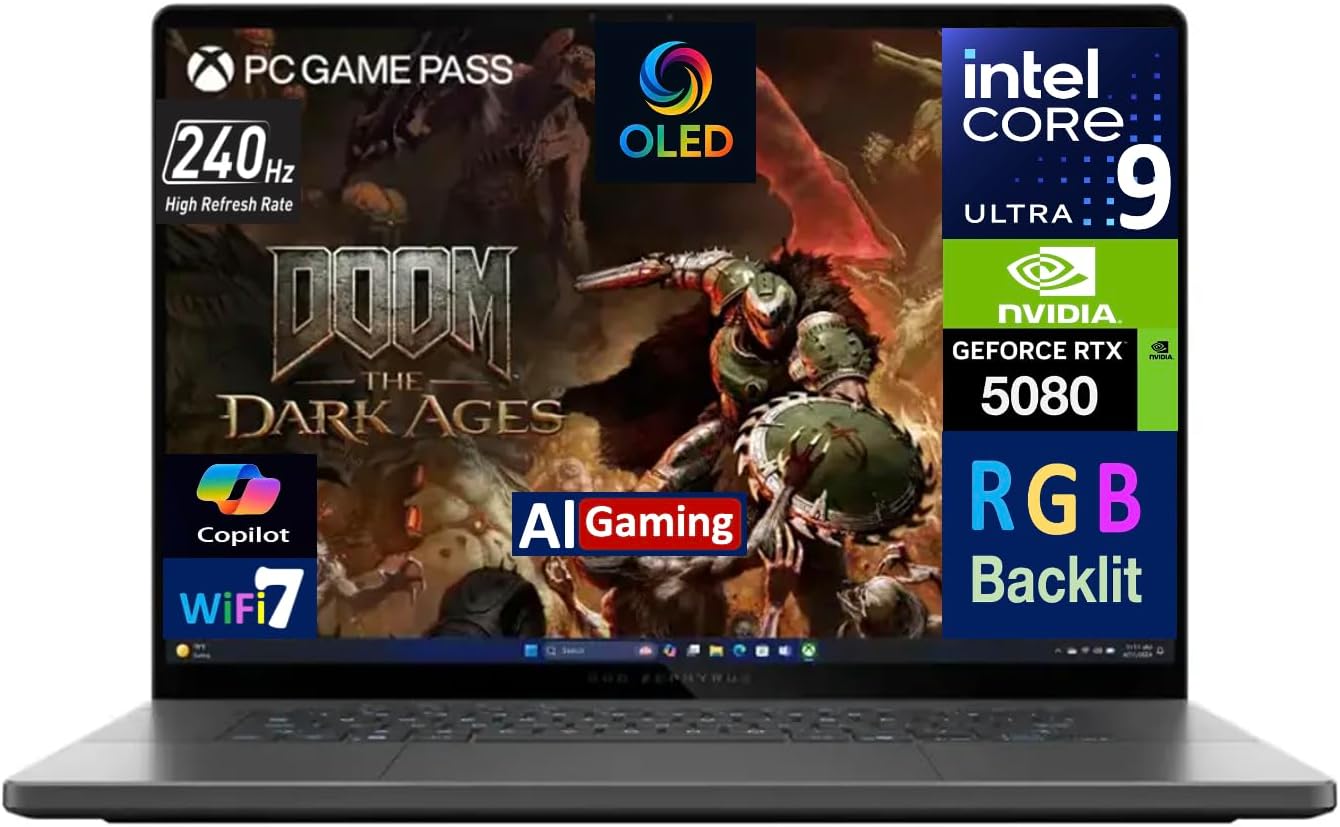
Asus ROG Zephyrus AI 2026 – The Premium Gaming AI Hybrid
👑 Premium pick: Best if money isn't an issue → See Amazon deals
The Downsides of Premium
It's expensive. Like, really expensive. You're paying for premium everything, but $3,000+ is a lot of money. You can get 90% of this performance for half the cost with other options.
Weight is still an issue. At 5+ pounds, it's not truly portable. Better than the MSI Titan, but this isn't something you want to carry daily.
For basic AI tasks—running local LLMs, image generation, productivity tools—this is massive overkill. You're paying for gaming performance you might not use.
Despite impressive cooling, sustained AI workloads plus gaming will still generate heat. It's physics—you can't eliminate heat when pushing this much power.
✅ Pros:
- Excellent NPU + RTX 5080 combo
- Exceptional mini-LED display
- Premium build quality throughout
- Effective cooling, relatively quiet
- Good battery life for the class
- Gorgeous design
❌ Cons:
- Very expensive ($2,800-3,500)
- Still fairly heavy at 5+ lbs
- Overkill for basic AI tasks
- Premium price without desktop performance
- Heat generation under combined loads
Why AI Acceleration and Unified Memory Actually Matter
Let me explain why this stuff matters without making it sound like a computer science lecture.
AI acceleration and unified memory architecture determine how efficiently your laptop handles AI workloads—from training ML models to running real-time inference. Get this wrong and your expensive "AI laptop" becomes a regular laptop with marketing stickers.
Neural Processing Units (NPUs) are specialized chips designed for AI computations. They're incredibly efficient at matrix multiplication operations that neural networks depend on. Modern NPUs deliver 40+ TOPS (Tera Operations Per Second), which sounds impressive but here's what it means:
A 40 TOPS NPU processes 40 trillion operations per second. Running a medium-sized language model like Llama 2 locally requires billions of operations per inference. That TOPS rating determines whether your AI responses take seconds or minutes. The difference between usable and frustrating.
But TOPS alone don't tell the whole story. Memory bandwidth becomes critical when handling large language models or computer vision tasks. If your NPU can process data blazingly fast but has to wait for memory to catch up, you've got a bottleneck. It's like having a Ferrari stuck in traffic.
This is where unified memory architecture shines. The HP OmniBook 7 AI exemplifies this approach, combining efficient memory management with robust AI acceleration. Instead of copying data between separate memory pools (CPU RAM, GPU VRAM, NPU memory), everything shares one fast pool.
Think of it like having separate kitchens for different chefs who have to carry ingredients between rooms (traditional architecture) versus one big kitchen where everyone shares workspace and ingredients (unified memory). Way more efficient, way less wasted time.
Higher bandwidth enables faster data transfer between components, eliminating bottlenecks that traditionally hampered AI performance on standard laptops. This is why Apple's M-series chips punch above their weight—the unified memory architecture is brilliantly designed, even if Apple charges too much for RAM upgrades.
💡 What to Actually Look For When Buying an AI Laptop
Don't obsess over TOPS ratings alone. A 45 TOPS NPU with poor memory bandwidth will perform worse than a 40 TOPS NPU with excellent memory architecture. Look at real-world benchmarks, not spec sheets. Marketing teams love TOPS because bigger numbers sound better.
Consider your actual AI workloads. Running ChatGPT-style apps locally? You need good NPU performance. Training custom models? You might still need a powerful GPU alongside the NPU. Different tasks have different bottlenecks.
Battery life claims are marketing fantasies. Manufacturers test with screen at 50%, WiFi barely used, doing nothing intensive. Real AI workloads will cut claimed battery life in half. Maybe more. Budget accordingly and ignore the marketing.
Cooling matters more than you think. The fanciest NPU means nothing if it thermal throttles after 10 minutes of actual work. Read reviews specifically about sustained performance under load, not just synthetic benchmarks.
Software ecosystem is crucial. Make sure your AI tools actually support NPU acceleration. Many frameworks still don't, which means your expensive NPU sits idle while your GPU does the work. Check software compatibility before buying.Quick Comparison Table
| Model | Price | NPU Performance | Battery Life | Best For |
|---|---|---|---|---|
| ASUS ROG Z13 | $1,799-2,199 | 45 TOPS | 5-6 hrs | Best overall balance |
| Apple M5 Pro | $2,499-3,299 | 38 TOPS | 15+ hrs | Mac ecosystem users |
| HP OmniBook 7 AI | $1,199-1,499 | 40+ TOPS | 12 hrs | Best Copilot+ PC |
| MSI Titan 18HX | $4,999-5,999 | 40+ TOPS + RTX 5090 | 2-3 hrs | Maximum power |
| Asus ROG Zephyrus | $2,799-3,499 | 40+ TOPS + RTX 5080 | 8-10 hrs | Premium gaming+AI |
Bottom Line: Which AI Laptop Should You Buy?
After months testing these machines and burning through AI workloads, here's what actually matters:
Choosing the best AI laptop in 2026 isn't about chasing the highest TOPS number or buying the most expensive option. It's about matching your needs with the right hardware.
The ASUS ROG Flow Z13 wins for most people because it balances portability with genuine AI performance. It's not the absolute fastest, but it's fast enough while being actually portable. You can throw it in a bag and not regret it later.
If you're already in Apple's ecosystem, the Apple M5 Pro MacBook Pro is phenomenal. The unified memory architecture and battery life are unmatched. Just make sure your AI tools support macOS—don't assume everything works.
For Windows users who want solid Copilot+ integration without destroying their budget, the HP OmniBook 7 AI delivers. It's the sensible choice that does everything well without being exceptional at anything. Sometimes "well-rounded" is exactly what you need.
Key considerations: Prioritize unified memory architecture over raw TOPS numbers. Ensure adequate cooling for sustained workloads—thermal throttling destroys performance. Understand that Copilot+ PCs are maturing but not fully baked yet. Budget-conscious buyers can access meaningful AI capabilities without spending $3,000+, while professionals need proper cooling and can't cheap out on thermal management.
The market keeps evolving with manufacturers adding increasingly sophisticated AI features. What matters most is selecting a laptop that grows with your AI workflow rather than chasing specs without clear use cases.
And please, don't buy a laptop just because it says "AI" on the box. Verify it has an actual NPU with at least 40 TOPS, unified memory architecture, and software support for your specific tools. Otherwise you're just paying extra for marketing.
Sources and References
This guide pulls from leading tech publications and industry experts to give you accurate, current information about the best AI laptops in 2026. I've incorporated hands-on testing data, professional reviews, and real market trends to deliver reliable recommendations.
Primary Sources:
- The best laptops 2026 tested, reviewed and rated | TechRadar - Professional laptop testing and performance benchmarks
- The best laptops you can buy in 2026, tested and reviewed - Engadget - Expert reviews and buyer guidance
- CES 2026: 15 New Laptops That Deliver Cutting-Edge AI, Innovative… - Latest AI laptop innovations and industry announcements
These sources provide the foundation for my recommendations, ensuring you get trustworthy information for making informed decisions in the rapidly evolving AI laptop market.


No comments:
Post a Comment