I've used enough AI assistants to notice a frustrating pattern: they're getting much better at answering questions, but your phone still expects you to do almost everything yourself.
Want to book a flight? Open the airline app.
Need a hotel? Open another app.
Need a ride, update your calendar and send someone the itinerary? You already know what happens next: more apps, more taps, more context switching.
STEPX Neo is trying to eliminate that workflow. Instead of putting another chatbot inside a conventional smartphone, StepFun has built an operating environment around an AI agent called Amoo.
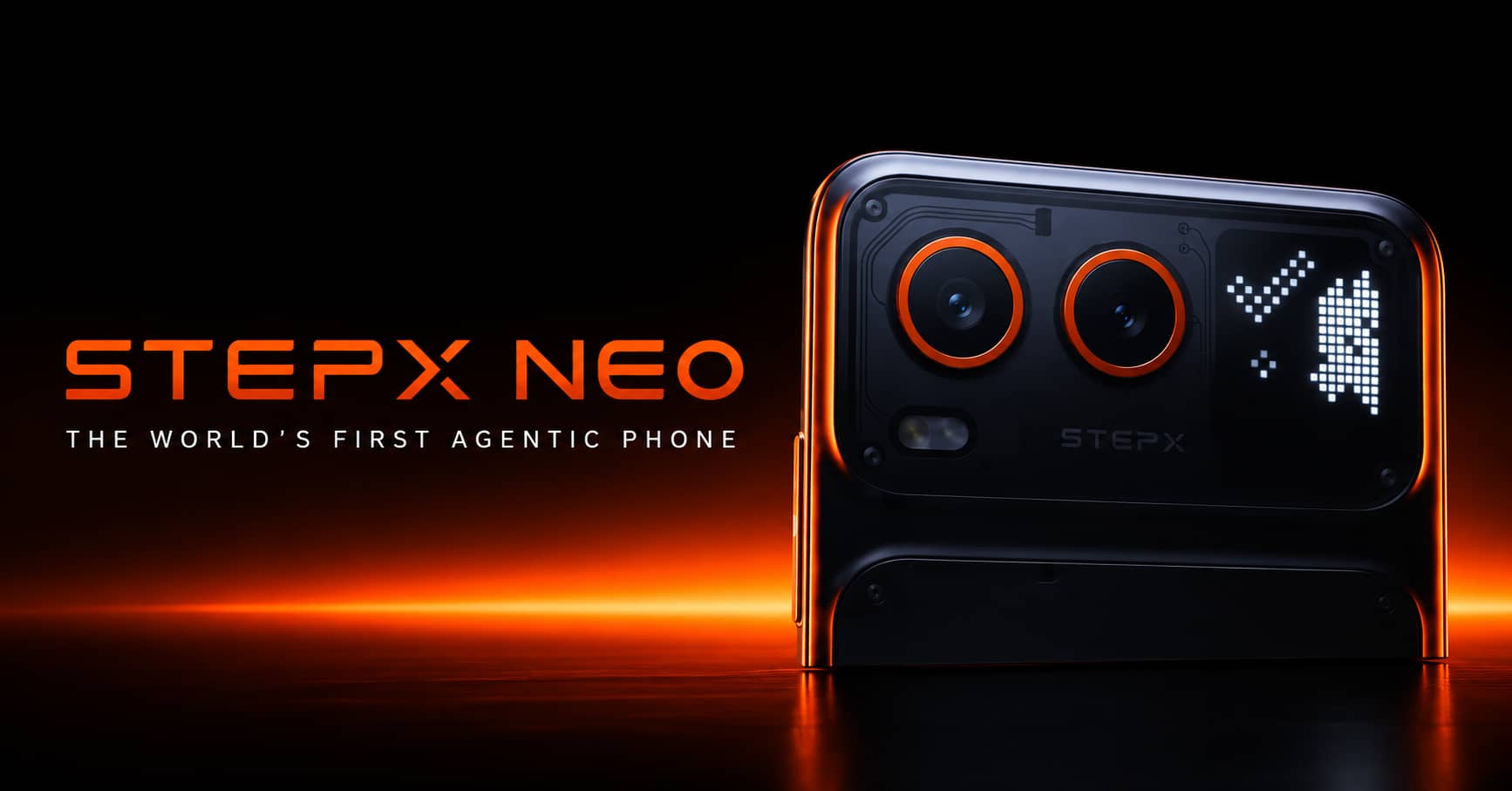
STEPX Neo is designed around Step AOS and the Amoo personal AI agent, with cross-application task execution at the center of the experience.
What Makes STEPX Neo an “Agentic” Phone?
Most smartphones with AI still work fundamentally the same way. You open an app, type something into an AI feature and receive an answer.
STEPX Neo starts from a different assumption: the AI should be able to execute the task, not merely explain how you can execute it.
StepFun says its Amoo personal agent can translate a natural-language goal into a sequence of actions across applications, system functions and web services.
You could give it an objective rather than a list of instructions. The system is then supposed to figure out which capabilities it needs and execute the workflow.
That's the core distinction between a chatbot and an agent. A chatbot responds; an agent attempts to move the world forward.
Amoo Is the AI Layer You Actually Interact With
Amoo is StepFun's personal AI agent for STEPX. The company describes it as having perception, memory, decision-making and action capabilities.
The interface uses what StepFun calls a Natural User Interface. Voice, visual input and natural-language instructions are intended to replace long sequences of manual interaction.
That means you don't necessarily have to know which app should handle the task. You tell Amoo what you want accomplished.
From Command to Outcome
- Traditional phone: Choose the app, find the function, enter the information and finish the workflow yourself.
- AI assistant: Ask a question and receive information or guidance.
- Agentic phone: State the goal and let the agent determine which capabilities and services are needed.
- Human role: Define the intent, review important actions and intervene when necessary.
The “Atomic Capability Engine” Is the Part Developers Should Watch
The most technically interesting concept in Step AOS is something StepFun calls the atomic capability engine.
Instead of treating every application as a sealed destination, Step AOS exposes device functions as smaller capabilities that an agent can combine.
StepFun says these capabilities cover communication, applications, files and system tools and use the Model Context Protocol, or MCP, to make them accessible.
That sounds like an implementation detail. It isn't.
It is potentially the foundation of the entire agentic-phone idea.
The agent becomes useful when it can compose capabilities from different places. Without that layer, the AI is just another interface sitting on top of an app ecosystem that was never designed for autonomous execution.
The overlooked architectural shift
STEPX Neo is trying to change the smartphone's fundamental abstraction. The user sees “book my trip”; the operating system sees a collection of capabilities that can be composed into a workflow.
Why Step Edge Matters
StepFun also developed Step Edge, a foundation model designed specifically for device-side operation.
The idea is straightforward: some tasks should be handled locally on the phone instead of sending every request to a remote server.
Local processing can reduce latency, provide functionality when connectivity is limited and potentially reduce the amount of sensitive information that needs to leave the device.
StepFun describes an architecture in which lighter workloads can run locally while more complex workloads can be coordinated with cloud models.
That creates a hybrid system. The phone doesn't have to be powerful enough to run every possible model locally.
It needs to be smart enough to determine what can be handled on-device and when additional cloud computation is necessary.
STEPX Neo Can Remember Your Preferences
Agentic systems become much more useful when they remember context. StepFun says Amoo can learn user preferences over time.
That could mean understanding recurring choices instead of asking the same questions every time. A travel request, for example, could potentially take into account previously expressed preferences.
The value is obvious. A personal agent becomes more useful when “my usual” can actually mean something.
But memory also creates a bigger privacy responsibility. A system that merely answers questions doesn't need to remember every preference you have.
An agent that can act on your behalf does.
The Phone Can Work Across Real Services
This is where STEPX Neo moves beyond the concept demo. StepFun announced integrations across services including Alipay, Ctrip, Didi, Meituan, WPS, CapCut, Baidu and JD.
These cover payments, travel, ride-hailing, local services, office productivity and content creation.
That ecosystem is critical. An agent can be extremely intelligent and still be useless if it has nowhere to act.
Integrations give Amoo actual capabilities. It can potentially move from reasoning about a task to interacting with services that can complete it.
Conceptual representation of the agentic workflow described by StepFun and coverage of its platform integrations.
The Rear Display Is More Than a Camera Trick
STEPX Neo has another unusual hardware feature: an interactive auxiliary display on the rear.
On the surface, that might sound like another novelty screen. Its real value depends on how closely it is integrated with the agent.
A small secondary interface could expose task status, notifications or agent activity without forcing the user to interact with the main screen.
IT Home's on-site WAIC report showed the physical device running Step AOS, with an AI work-status indicator visible in the interface.
That's potentially significant because agentic systems create a new interface problem: users need to know what the AI is doing.
Amoo cannot simply disappear in the background while performing important actions. The user needs visibility into the current state.
Security Is the Make-or-Break Issue
An AI assistant that answers a question can make a mistake. An AI agent that can send messages, make reservations or interact with payments can create consequences.
StepFun has described a security architecture involving trusted execution, action auditing, just-in-time permissions and rollback.
The basic idea is sensible: give the agent enough authority to perform useful work while making its actions visible, constrained and reversible.
But this is an area where marketing claims need to be separated from independent verification. Public research has not established an independent security audit of the entire STEPX Neo phone and Step AOS stack.
The permission question matters more than the AI model
Before trusting any agentic phone, ask a simple question: Can I see exactly what the agent is about to do, restrict what it is allowed to do and undo important actions?
STEPX Neo Is Not Yet a Normal U.S. Smartphone
This is particularly important for U.S. readers. STEPX Neo has been unveiled and demonstrated, but its full consumer commercialization picture remains unclear.
As of the latest detailed reporting available, public sources had not established a verified retail price, consumer order page, final hardware specification sheet or confirmed international launch schedule.
That means readers should be careful with websites publishing detailed tables for RAM, storage, battery size, charging speed or an exact U.S. price.
Many of those specifications are currently presented as rumors or estimates rather than confirmed StepFun specifications.
The safest way to evaluate STEPX Neo right now is as a demonstrated product direction whose software architecture is more clearly documented than its final retail hardware configuration.
Why This Matters to Apple, Google and Samsung
STEPX Neo doesn't need to become a global bestseller to matter.
Its importance is that it demonstrates a possible alternative to the app-centric smartphone model that has dominated mobile computing for years.
Apple, Google and Samsung have all been moving toward more capable AI assistants. But the hard problem remains execution across applications.
The app model was built around humans navigating interfaces. Agentic computing asks software to navigate those interfaces on behalf of humans.
That's a fundamental tension.
The company that solves it reliably could make the smartphone feel dramatically simpler without necessarily removing the apps themselves.
What Developers Should Watch
Capabilities instead of screens
Developers may increasingly need to expose machine-readable actions rather than designing every workflow around buttons and menus.
Agent permissions
Applications that give agents too much authority create security risks. Applications that give them too little authority become useless to an agent.
State visibility
Users need to know whether an agent is planning, waiting, asking for approval or executing an action.
Reversibility
Agentic software should ideally make important operations reversible. “Undo” becomes significantly more important when the software can act autonomously.
Cross-app context
The biggest benefit will come from connecting workflows that currently live in separate applications. An agent that can only work inside one app isn't delivering the full agentic promise.
Famous AI Pioneer Marvin Minsky Saw This Coming
The idea behind an agentic smartphone reaches much further back than today's AI boom. AI pioneer Marvin Minsky spent decades thinking about machines made from interacting systems rather than a single “brain.”
“We can make a machine intelligent by giving it many different ways of thinking.”— Marvin Minsky, AI researcher and co-founder of MIT's Artificial Intelligence Laboratory
STEPX Neo is interesting for a similar reason. Its agent isn't just a language model answering questions.
It is supposed to coordinate memory, models, device functions, applications and services into a single workflow.
Watch STEPX Neo in Action
STEPX Neo has been demonstrated publicly since its July 2026 unveiling. The following video shows the agentic-phone concept.
A hands-on explanation of STEPX Neo and its agentic smartphone concept.
Pros and Cons of the STEPX Neo Concept
Why It Is Interesting
- AI agent is integrated into the operating environment rather than being only a separate application.
- Designed to execute multi-step workflows across apps and services.
- Step Edge provides a path toward on-device agentic processing.
- Atomic capabilities can potentially make device functions easier for agents to compose.
- Strong ecosystem integrations give the agent practical places to act.
What Remains Unclear
- Final consumer hardware specifications have not been fully disclosed.
- Verified retail pricing and broad international availability remain unclear.
- Independent security testing of the complete platform is limited.
- Agent errors could have more serious consequences than ordinary chatbot mistakes.
- The long-term success of the platform depends on ecosystem support.
What Most People Are Missing About STEPX Neo
The biggest mistake is thinking STEPX Neo is mainly about having a smarter voice assistant.
That's not the ambitious part.
The ambitious part is the attempt to change the relationship between humans and applications.
Today, the app is the unit of interaction. You know which service you need, open it and operate its interface.
STEPX Neo flips that around. The user's goal becomes the unit of interaction.
The operating system is then responsible for deciding which capabilities and services should be combined to reach that goal.
That sounds like a small interface improvement. It isn't.
It moves the smartphone toward an intent-first computing model.
And that could be one of the biggest changes to personal computing since the app store itself.
The Bottom Line
STEPX Neo may eventually become a major smartphone platform, or it may remain an ambitious experiment. It is too early to know.
But its underlying idea deserves serious attention.
StepFun is trying to build a smartphone around an AI agent that can understand intent, remember context, choose capabilities and execute workflows across services.
Step AOS provides the environment. Amoo provides the agent. Step Edge provides the local model layer. The atomic capability engine provides the bridge between the agent and the phone's functions.
Those pieces are more important than any rumored RAM or battery number.
The biggest challenge won't be intelligence. Modern AI models are already remarkably capable.
The harder challenge is trustworthy action.
People may happily let an AI summarize an email. They will think very differently about an AI sending that email, paying a bill or booking a flight.
That means permission controls, audit trails, visibility and rollback may ultimately matter more than benchmark scores.
There's another challenge too: ecosystem support. An agent needs access to useful capabilities, and those capabilities need to be exposed safely.
That's why STEPX Neo is worth watching even if you never buy one. It represents a different philosophy for what a smartphone could become.
The phone of the future may not ask which app you want to open. It may simply ask what you want done.
The AI Agent That Browses for You
While agentic smartphones rethink mobile apps, autonomous browser agents are completely transforming the open web. Read our deep dive into the Strawberry browser AI agent to see how next-gen reasoning models can navigate websites, research data, fill out forms, and execute complex workflows completely hands-free.
Read the Strawberry AI Guide →Sources
Gadgets 360: StepFun unveils StepX Neo as world's first agentic smartphone
IT Home: STEPX Neo hands-on at WAIC 2026
Gizmochina: STEPX Neo and Step AOS architecture
South China Morning Post: StepFun's STEPX Neo announcement
Breachroad: Independent security analysis of STEPX Neo
YouTube: STEPX Neo — World's First Agentic AI Smartphone Explained
Frequently Asked Questions
What is STEPX Neo?
STEPX Neo is a smartphone unveiled by Chinese AI company StepFun around an agentic operating system called Step AOS and an integrated personal AI agent called Amoo. StepFun describes it as the world's first mass-market agentic smartphone.
What can the Amoo AI agent do?
StepFun says Amoo can understand natural-language goals and execute multi-step workflows across applications, device functions and web services. Announced ecosystem integrations include travel, payments, ride-hailing, local services, office productivity and content creation.
What is Step AOS?
Step AOS is StepFun's agent-native operating environment for STEPX devices. It uses what the company calls an atomic capability engine to expose device functions and services as capabilities that Amoo can combine into workflows.
What is Step Edge?
Step Edge is StepFun's foundation-model technology designed for device-side AI processing. The architecture is intended to handle lighter workloads locally while allowing more complex tasks to work with cloud models.
Can you buy STEPX Neo in the United States?
Public reporting has not established a verified U.S. retail channel, consumer order page or confirmed broad international launch for STEPX Neo. Readers should also treat detailed online hardware specifications and prices as unverified unless they come directly from StepFun.


No comments:
Post a Comment