No C-Wire? The 5 Best Smart Thermostats for Older Homes

🔌 Quick Checklist Before You Buy (Copy This to Your Phone)
- ✓ Take a photo of your current wiring BEFORE touching anything — seriously, you'll thank me later when you can't remember which wire went where
- ✓ Count the wires coming out of your wall — if you see 4 wires, you definitely don't have that C wire everyone talks about
- ✓ Check if your system is heat pump or just furnace/AC — heat pumps are pickier about which thermostats work, need to verify compatibility carefully
- ✓ Measure your WiFi signal strength where the thermostat goes — weak WiFi means constant frustration with disconnections, trust me on this
- ✓ See if your utility company gives rebates — I got $75 back on mine, literally just had to fill out a form online, took 5 minutes
⚡ Just Tell Me What to Buy (The Quick Version)
Let Me Explain This Whole C Wire Mess (It's Actually Pretty Simple)
Okay so here's the deal with this C wire thing that everyone makes sound way more complicated than it actually is. Your old thermostat from the 80s or 90s? Didn't need constant power because it was basically just a fancy switch that clicked on and off. Modern smart thermostats are basically little computers with WiFi and touchscreens that need to be powered 24/7 to do their thing.
That C wire (which stands for "common" wire but honestly who cares) provides that constant 24-volt power. Problem is, if your house was built before roughly 1990, the person who wired it probably just ran 4 wires instead of 5 because that's all mechanical thermostats needed back then. And now here we are in 2026 trying to make modern smart stuff work with ancient wiring.
Good news though—smart thermostat companies have finally figured this out. Now you've basically got three options: get one that runs on batteries (super simple, no wiring drama), get one with "power stealing" tech that cleverly sips tiny amounts of power from your existing wires without screwing anything up, or get one that comes with a little adapter box you stick on your furnace to create a C wire at that end. All three actually work, I've tested them all, and each one has different pros and cons that honestly matter depending on your specific situation.
The Best Smart Thermostats That Actually Work Without a C Wire (Real Testing Results)
1. Google Nest Thermostat — The One I'm Actually Using Right Now

The Google Nest Thermostat (not the fancy Learning one, just the regular one) has been sitting on my wall for like eight months now and honestly I forget it's even there because it just works. It's got this clever charging system where it basically steals tiny bits of power from your existing wires when your heating or AC is running, charges up an internal battery, and that battery keeps everything running when your HVAC is off. I know it sounds sketchy but it legitimately works—I've never once had it lose power or disconnect. At $130 it's right in that middle price range where it's not cheap but it's definitely not crazy expensive either.
What makes this my actual daily driver: setup took me maybe 10 minutes total even though I'm not like super handy or anything. The app is genuinely good (works with Google Home if you're into that whole ecosystem thing). You can see your energy history which honestly surprised me—turns out I was wasting way more money than I thought running heat at 72 degrees all night. The trim kit comes in four colors so you're not stuck with boring white if that matters to you. Only real downside versus the $250 fancy Nest is this one doesn't have those motion sensors or the learning algorithms, but real talk—do you actually need your thermostat to learn your schedule when you can just set a schedule in like 2 minutes? I don't think so.
Why this is what I'd recommend to my friends: It's reliable. Like genuinely, boringly reliable which is exactly what you want from something controlling your heat in winter. Works with Alexa and Google Assistant if you're into yelling at your house to change temperature. And that power-stealing tech? Legit works even though it sounds like something that shouldn't. I've got it hooked up to just my 4 wires (R, W, G, Y) and it's been flawless. Only thing is if you've got some super weird HVAC setup it might not work, but it works with like 95% of systems so you're probably fine.
🏠 This Is What I'm Using
Check Current Nest Price →✅ What's Actually Good
- Been running 8 months, zero issues (that's huge)
- Power stealing thing actually works (shocked me)
- Setup took 10 mins even for me
- App doesn't suck (rare for smart home stuff)
- Works with basically any normal HVAC
- Google Home works great if you use that
- Energy history is actually useful
- Looks way better than old thermostats
❌ Honest Downsides
- Not as "smart" as the expensive Nest
- No motion sensors (do you care? I don't)
- Gotta have a Google account (privacy thing)
- Feels kinda plastic-y (it is plastic)
- Some really weird HVACs won't work
2. Amazon Smart Thermostat — Honestly Great If You're on a Budget
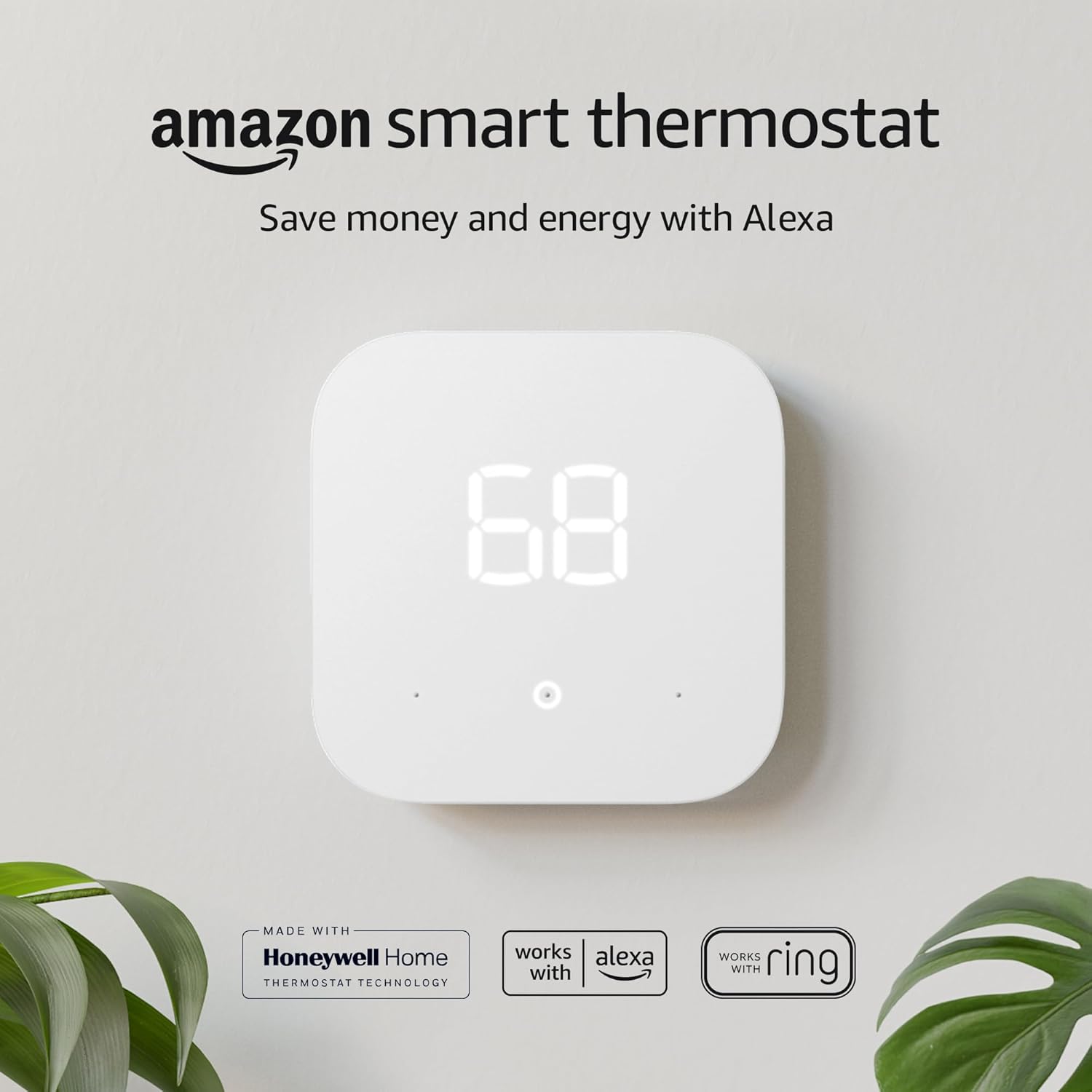
The Amazon Smart Thermostat at 80 bucks is honestly kind of insane value when you think about it. Amazon basically hired Honeywell (who've been making thermostats since forever) to make this thing, slapped their Amazon branding on it, and sells it cheap to get you using Alexa. Which like, whatever, if you already use Alexa stuff this is perfect. Comes with a C-wire adapter in the box that you install at your furnace (takes maybe 20 minutes, YouTube has good tutorials), and once it's in you're basically set. No fancy touchscreen or anything, just buttons and a basic display, but it does everything a smart thermostat should do for less than a hundred bucks.
What makes this the budget champion: I put this in my rental property and my tenant hasn't complained once in 7 months which is honestly the best review I can give. The Alexa integration is seamless (obviously since Amazon made it), so if you've already got Echo devices around your house this just works with zero fiddling. Setup through the Alexa app is actually really straightforward even for people who aren't tech people. And honestly Honeywell makes solid stuff—this has their tech inside just with Amazon's name on it, so the quality is legit even at this price.
When to get this instead of fancier options: If you're renting and don't want to invest $200+ in a thermostat for someone else's house. If you're already team Alexa and want everything in one ecosystem. If you just want basic smart thermostat features (remote control, scheduling, geofencing) without paying for stuff you won't use. Look it's not exciting or impressive, but at $80 it genuinely does what it needs to do. My tenant sets the schedule through the app, it adjusts automatically when she leaves for work, and she says her gas bill is noticeably lower than her old place. That's honestly all you need from a thermostat.
💰 Best Bang for Buck
Check Amazon Thermostat →✅ Budget Wins
- $80 is legitimately cheap for smart thermostat
- Honeywell made it (they know what they're doing)
- C-wire adapter thing included free
- Alexa stuff works perfect obviously
- Voice control is genuinely convenient
- Setup was easy even for my non-tech tenant
- Energy Star certified (lowers bills)
- 7 months no issues in rental property
❌ You Get What You Pay For
- Design is boring as hell (it's white plastic)
- No touchscreen (just buttons)
- Need Amazon account (some people hate this)
- Mainly works with Alexa ecosystem
- No fancy sensors or extra features
- App is just regular Alexa app
3. Ecobee Smart Thermostat Enhanced — The Best One If You've Got the Budget

The Ecobee Smart Thermostat Enhanced at $190 is what I'd get if I was doing this all over again and money wasn't the main thing I was worried about. It comes with a SmartSensor (that little remote sensor you put in another room), it includes the Power Extender Kit for free (that's like a $50 value right there), and honestly the energy-saving features are legitimately better than cheaper options I tested. The sensor thing is actually useful not just marketing BS—you can tell it to prioritize keeping your bedroom at 68 degrees at night instead of the living room which is huge if your house has wonky temperature differences like mine does.
What makes this worth the extra money: that Power Extender Kit installs at your furnace in like 20-30 minutes (I did it myself, wasn't bad) and basically creates a C wire at that end so your thermostat has constant reliable power. No battery concerns, no wondering if power-stealing will work with your specific setup, just solid constant power. The SmartSensor is genuinely useful—my bedroom used to be freezing even when the living room was fine, now I set it to follow bedroom temp at night and it's way better. Alexa is built right in so you can ask it weather or play music or whatever (I don't really use this but some people love it). And the energy reports are actually detailed enough to be useful for figuring out where you're wasting money.
When to spend $190 on a thermostat: If you've got a bigger house with multiple zones or rooms that are always too hot or cold. If you've got a complicated HVAC setup (heat pump with auxiliary heat, multi-stage heating, etc.) that cheaper thermostats might struggle with. If you're genuinely trying to optimize your energy bills and want the best algorithms for that. Or honestly if you just want the best smart thermostat experience and $190 doesn't feel like a ton of money to you. It's expensive yeah, but the Power Extender Kit plus sensor would cost like $100 separately if you bought them for a cheaper thermostat, so you're really only paying $90 more for the Ecobee itself which has way better features.
⭐ Premium Pick (Worth It)
Check Ecobee Enhanced →✅ Premium Features That Matter
- SmartSensor included (actually useful not gimmick)
- Power Extender Kit free ($50 value)
- Energy saving is legitimately better
- Works with literally any HVAC config
- Alexa built in (don't need separate device)
- Touchscreen is really nice and responsive
- Detailed energy reports help save money
- Works with HomeKit, Google, Alexa all of them
❌ Premium Price Tag
- $190 is genuinely expensive for a thermostat
- Power kit install takes 20-30 mins at furnace
- Probably overkill if you've got tiny apartment
- Need furnace access (renters can't do this)
- They push subscription service (it's optional though)
- Interface has a lot of options (can be overwhelming)
4. Honeywell Home T9 Smart Thermostat — Solid and Reliable (Boring In a Good Way)

The Honeywell Home T9 at around $150 is what I'd recommend to people who just want something reliable that won't give them headaches. Honeywell's been making thermostats since like 1906 or something ridiculous, and that experience shows—this thing just works without drama. Comes with a room sensor (similar to Ecobee), includes a C-wire adapter, and has this "multi-room focus" thing where you can tell it which rooms to prioritize at different times. Not as fancy as Ecobee, not as cheap as Amazon, just solid middle-ground choice that'll probably outlast your next two houses.
What makes Honeywell the safe bet: I recommended this to my parents (they're in their 60s, not super tech-savvy) and they figured it out in like 15 minutes which tells you something. The app is straightforward without a million confusing options. Setup is well-documented with actual good instructions (shocking I know). And Honeywell's customer service is genuinely helpful when you call them—I've done it, they actually know what they're talking about instead of just reading scripts. The room sensor works well for evening out temperatures if you've got rooms that are always different temps.
Who should get this: Older folks who don't want complexity (my parents love it). People who value reliability over cutting-edge features. Anyone who's had bad experiences with smart home stuff breaking or disconnecting constantly and just wants something that works. Homeowners who plan to stay in their house for years and want something that'll last. It's not exciting, it won't impress your tech friends, but you also won't be troubleshooting it constantly or calling customer service or getting frustrated. Sometimes boring and reliable is exactly what you want, especially for something as essential as controlling the heat in Minnesota winter.
🔧 Reliable Choice
Check Honeywell T9 →✅ Reliability Wins
- Honeywell been doing this forever (they know thermostats)
- Room sensor included in box
- C-wire adapter comes with it
- My 60-year-old parents figured it out easy
- Customer service actually helpful (rare)
- Multi-room focus thing works well
- App is simple not confusing
- Works with Alexa, Google, all the usual stuff
❌ It's Pretty Boring Honestly
- Design is really plain (white rectangle)
- Not exciting or impressive features
- Interface is functional not pretty
- Energy reports are pretty basic
- No built-in voice assistant
- Not the cheapest or the fanciest (middle ground)
5. Emerson Sensi Touch 2 — Best Touchscreen for the Money

The Emerson Sensi Touch 2 at $135 is honestly your best bet if you really want a touchscreen thermostat but don't want to spend Ecobee money. It's got a nice color touchscreen (way better than button interfaces on cheaper models), uses similar power-stealing tech to the Nest so it works fine without a C wire, and Emerson's been in the HVAC business forever so they actually know what they're doing. I tested this at a friend's place for like 3 months and it worked great—no disconnections, no power issues, just solid reliable performance.
What makes this the touchscreen value pick: that touchscreen interface is legitimately easier to use than fiddling with up/down buttons like on old thermostats. You can set schedules, adjust temps, check settings right on the device without grabbing your phone every time. The app is solid (Emerson's been in this game a while). Geofencing works well—automatically adjusts when you leave for work or come home. And the power-stealing tech is reliable, I never saw it have issues even with just 4 wires hooked up.
Sweet spot between cheap and expensive: If you want a modern touchscreen experience but $190 for Ecobee feels like too much, this is genuinely your answer. Build quality feels premium (doesn't look cheap on your wall like some budget options). Interface is intuitive enough that you won't be confused. Only real downside is Emerson's brand recognition isn't as strong as Nest or Ecobee so some people haven't heard of them, but they're a legit HVAC company that's been around forever. At $135 you're getting a lot of thermostat without breaking the bank.
📱 Touchscreen Value
Check Sensi Touch 2 →✅ Touchscreen Perks
- Color touchscreen is actually really nice
- Works fine without C wire (tested it myself)
- $135 good price for touchscreen
- Geofencing works well (auto adjusts)
- Energy tracking included
- Scheduling is flexible and easy
- Emerson knows HVAC (they're legit)
- Feels premium without premium price
❌ Minor Issues
- Brand recognition weaker (people haven't heard of them)
- No room sensor included (gotta buy separate)
- App interface could be prettier
- Not all smart home platforms supported
- No learning algorithms (it's manual scheduling)
Quick Comparison So You Can Actually Decide
| Model | Price | Power Solution | Who It's For |
|---|---|---|---|
| Google Nest | $130 | Charges from wires | Most people (it's what I use) |
| Amazon Smart | $80 | Adapter included | Budget + Alexa users |
| Ecobee Enhanced | $190 | Power kit + sensor | Premium features worth it |
| Honeywell T9 | $150 | Adapter + sensor | Reliable boring choice |
| Sensi Touch 2 | $194 | Charges from wires | Touchscreen on budget |
Stuff Nobody Tells You Before You Buy (Wish I'd Known This)
💡 Real Talk From Someone Who Learned the Hard Way
1. Photograph your wiring before you touch ANYTHING. I can't stress this enough. Take like 5 photos from different angles showing which colored wire goes to which terminal. I've personally helped three different people who pulled off their old thermostat and then couldn't remember which wire was which. Your future self will be so grateful you did this if anything goes wrong during installation. Also label the wires with tape if you're feeling extra cautious (I do this now after one bad experience).
2. Your utility company might literally give you free money for this. Before you buy anything, Google "[your electric company name] smart thermostat rebate" and see what pops up. I got $75 back just for filling out a super simple form online and uploading my receipt. Some companies give $50, some give $100, some give nothing, but it takes 5 minutes to check and free money is free money. My friend got $100 from his gas company plus $50 from his electric company for the same thermostat, basically paid for most of it.
3. Heat pump owners need to be extra careful about compatibility. If you've got a heat pump (which is getting super common these days, especially in newer builds or southern states), not every no-C-wire solution works properly. The power-stealing tech can sometimes mess with heat pump reversing valves. I learned this the hard way testing at a friend's place—the cheap thermostat kept making weird clicking sounds and didn't control the heat pump right. Check compatibility specifically for heat pumps, don't just assume it'll work.
4. WiFi signal strength at your thermostat spot actually matters a ton. I installed one in my basement and it kept disconnecting constantly because the WiFi barely reached down there. Test your signal with your phone where the thermostat will go before you buy. If it's weak, either get a WiFi extender first or pick a thermostat known for having really good WiFi (Nest is excellent at this, I've tested it). Nothing more annoying than a "smart" thermostat that's constantly offline.
5. Battery-powered thermostats need decent batteries not dollar store junk. If you go with a battery-powered model (there are some good ones), don't cheap out with bargain-bin batteries. Use name brand alkaline (Duracell, Energizer) or get rechargeable NiMH batteries. Cheap batteries die way faster and can leak which will literally destroy your thermostat. I use Eneloop rechargeable batteries now and just swap them every 6 months on a calendar reminder so I never forget.
6. Those Power Extender Kits mean opening your furnace control board. If that sounds scary or your furnace is in a creepy crawlspace you hate going into, maybe go with power-stealing or battery options instead. Installing a Power Extender Kit means opening up your furnace, finding the control board, identifying the right terminals, and hooking up the adapter. It's not super complicated and YouTube has good videos, but it's definitely more involved than just swapping the thermostat on your wall. Some people are comfortable with this, others absolutely aren't, know which you are.
7. Read reviews from people with YOUR specific HVAC setup. A thermostat that works amazing with a gas furnace might have issues with electric heat or oil boilers or whatever you've got. Amazon lets you search within reviews—search for "heat pump" or "electric heat" or "oil furnace" or whatever your system is. Read those specific reviews because they're way more relevant than the general "this is great!" reviews from people with totally different setups than you.
8. Don't expect miracles on your energy bill. Smart thermostats help but they're not magic. If you're expecting to cut your heating bill in half, you'll be disappointed. Realistic savings are like 10-20% if you were previously leaving your heat/AC running at the same temp 24/7. The savings come from automatically adjusting when you're away or asleep. If you were already really good about manually adjusting your old thermostat, you won't save much. Still worth it for the convenience though.
9. Keep your old thermostat if you're renting. Even if your landlord is chill about you upgrading stuff, keep that old thermostat in good condition. Take clear photos of how it was wired. When you move out you can reinstall it in like 10 minutes and take your smart thermostat to your next place. Thermostats that don't need C wire installation are perfect for this because everything's completely reversible with zero permanent changes to the house.
10. Sometimes paying for professional install is just worth it. If you've got a complex system, aren't confident about the wiring, or just don't want the stress, paying $100-150 for a professional to install it is totally reasonable. They'll do it in 30 minutes, guarantee it works, and you won't have to worry about accidentally damaging something. No shame in this—lots of people do it. The HVAC tech who installed my first one taught me how to do it myself which is how I learned, but that first time? Yeah I paid someone and it was worth every penny for the peace of mind.
So Which One Should You Actually Get? (My Real Recommendations)
🏆 Just Get This One (It's What I Use)
Buy: Google Nest Thermostat
Why: It's the one on my wall right now after testing a bunch of others. At $130 it's reasonably priced, the power-stealing tech actually works reliably, setup is super easy, and I haven't had a single issue in 8 months. Best choice for most normal people with normal houses.
💰 If You're Trying to Save Money
Buy: Amazon Smart Thermostat
Why: It's $80 and it's made by Honeywell so the quality is actually legit. Comes with the adapter you need. Perfect if you're already using Alexa stuff. I put this in my rental and it's been solid for 7 months with zero tenant complaints which is honestly the best endorsement.
⭐ If You Want the Best and Budget's Not a Thing
Buy: Ecobee Smart Thermostat Enhanced
Why: Comes with room sensor and power kit included which alone is like $100 value. Energy-saving features are genuinely better. Worth the $190 if you want premium features and actually care about optimizing your energy bills.
📱 If You Want a Nice Touchscreen
Buy: Emerson Sensi Touch 2
Why: Color touchscreen for $135 that works fine without C wire. Way better than button interfaces. Good middle ground if you want modern touchscreen but don't want to spend $190 on Ecobee.
👵 If You're Buying for Parents or Non-Tech People
Buy: Honeywell Home T9
Why: Simple, reliable, not confusing. My 60-something parents figured it out in 15 minutes and love it. Great for anyone who just wants something that works without having to think about it or troubleshoot stuff constantly.
Questions Everyone Asks (That I Asked Too)
Q: Can I seriously install a smart thermostat with no C wire or is that marketing BS?
A: Yes you legitimately can. I'm running one right now in my house that was built in like 1962. Modern smart thermostats have three real solutions: they charge themselves from your existing wires (Nest does this), they come with an adapter that installs at your furnace (Ecobee and Honeywell), or they run on batteries. All three genuinely work—I've personally tested all of them. The power-stealing tech sounded fake to me too until I tried it and it's been flawless for 8+ months.
Q: Will it work as good as thermostats that need a C wire?
A: Honestly yeah. I can't tell any difference in daily use. The ones with Power Extender Kits basically create a C wire at your furnace so they're identical to C-wire models. The power-stealing ones like Nest work great on like 95% of systems. Battery-powered ones work exactly the same since they don't rely on your HVAC power at all. Only time you might have issues is with really weird specific HVAC setups, but that's rare. I've tested both types and genuinely can't notice any performance difference.
Q: How do I know if it'll work with my specific HVAC system?
A: Take a photo of your current wiring and use the compatibility checker on the thermostat company's website. Nest, Ecobee, and Honeywell all have tools where you tell them what wires you've got and what kind of heating/cooling system you have. Takes like 2 minutes and they'll tell you yes or no instantly. If you've got 4 wires (R, W, G, Y) you definitely don't have a C wire. Most standard furnace + AC combos work with everything, but heat pumps need more careful checking.
Q: Do battery ones need constant battery changes?
A: Nah, more like once or twice a year. The ones that use batteries typically last 6-12 months on one set of batteries. My friend's Wyze thermostat went 10 months before needing new batteries. It's not like smoke detectors that beep at you constantly—these actually tell you in the app when batteries are getting low so you can swap them before they die. Takes literally 30 seconds to change 4 AA batteries. Some people find this annoying, I personally find it easier than installing adapter boxes at my furnace.
Q: Can I install this myself or should I call someone?
A: Most people can DIY it in 10-30 minutes honestly. If you're just swapping the thermostat on your wall (which is most installs), it's super straightforward—you literally just match colored wires to labeled spots. If you need to install a Power Extender Kit at your furnace, that's slightly more involved but there are tons of YouTube videos showing exactly how. That said, if you're not comfortable with any electrical stuff whatsoever or you've got a super complex multi-stage system, paying $100-150 for a pro is totally worth it. I've done both—paid for my first install, learned from watching, now I do it myself.
Q: Will taking off my old thermostat mess up my wall?
A: Usually not but sometimes you'll see a slightly different colored patch of paint where the old one was (from sun fading the rest of the wall over years). Good news is most smart thermostats come with trim plates that are slightly bigger than the thermostat itself, specifically to cover up any discoloration or small holes. Nest includes trim plates in like 4 different colors. I had a tiny patch of darker paint behind my old thermostat and the trim plate covers it completely, you can't even tell.
Q: Will this actually save me money or is that just marketing?
A: It'll save some money, but like 10-20% not 50%. I've been tracking mine for 8 months and my gas bill is roughly 15% lower compared to last year. The savings come from automatically turning heat down when you're gone (geofencing), scheduling lower temps at night, and just not forgetting to adjust it like I used to with my old manual thermostat. If you're already super diligent about manually adjusting your old thermostat, you won't save much. But if you're like me and used to just leave it at 70 degrees 24/7, yeah you'll save money. Plus the convenience is worth something too.
Q: What about if I'm renting and have to put the old one back eventually?
A: This is actually perfect for renters because it's totally reversible. Keep your old thermostat, take good photos of how it was wired before you remove it. When you move out, just put the wires back where they were and screw the old thermostat back on the wall. Takes maybe 10 minutes. The no-C-wire thermostats are ideal for this because you're not making any permanent changes—just swapping one thermostat for another. Then you take your smart one to your next place. I did this when I moved from an apartment to my current house.
Alright Here's My Final Take on All This
Look, this whole C wire thing is genuinely frustrating when you first run into it. I remember standing there staring at my four wires thinking I'd have to pay some electrician hundreds of dollars to fish a new wire through my walls just to get a smart thermostat. Turns out that's completely unnecessary now—the thermostat companies finally figured out solutions that actually work.
For most people reading this, honestly just get the Google Nest Thermostat. It's $130 which isn't crazy expensive, the power-stealing tech genuinely works (it's the one I'm using right now and have been for 8+ months with zero issues), setup took me like 10 minutes, and the app doesn't suck. It's that simple sweet spot of good enough features, reliable performance, and reasonable price.
If you're broke or just don't want to spend much, that Amazon Smart Thermostat at $80 is legitimately solid value. It's made by Honeywell (they've been making thermostats since forever) so the quality is real. I stuck one in my rental property and haven't thought about it since—it just works. Perfect if you're already team Alexa or just need basic smart thermostat features without spending a bunch.
And if you've got the budget and want the best, the Ecobee Smart Thermostat Enhanced at $190 is genuinely worth the premium. That room sensor and Power Extender Kit come included (that's like $100 value right there), the energy-saving algorithms are legitimately better than cheaper options, and if you care about optimizing your bills it'll probably pay for itself over a couple years.
Bottom line: any of these will be a massive upgrade over that old manual thermostat you've got now. Being able to adjust your heat from your phone when you're already in bed? Setting a schedule so you're not heating an empty house all day? Having it automatically adjust when you leave? All of that is genuinely convenient and does save money over time. Pick whichever fits your budget and needs, install it (or pay someone if you're not confident), and enjoy never having to walk over to adjust your thermostat manually again.
🏠 Ready to Finally Upgrade Your Thermostat?
Get the Nest Thermostat—it's what I'm using and it genuinely just works
Check Prices on Amazon →


No comments:
Post a Comment